An experimental game about frustration, incomplete knowledge, and learning to navigate a system that actively works against you.
Project Overview
Room for Growth is an experimental single-player experience developed as part of the Echoes VIP program at the Rochester Institute of Technology. The game challenges players to care for a potted plant over a series of in-game days, while purposefully obfuscating the rules governing its survival.
Rather than focusing on mastery, the game is designed to evoke frustration, uncertainty, and incompleteness, as players realize that success is impossible within a system that withholds critical information.
My Contributions
Design Direction
I played a key role in shaping the project’s direction during pre-production:
- Helped define the shift from removing player control to futile interaction, ensuring that the player frustration comes not from a lack of agency but from a lack of satisfactory results.
- Explored how to maintain player agency within a predetermined outcome.
- Contributed to documentation and design discussions that clarified the game’s core emotional goals.
Mechanics Design
I helped design and prototype several of the game’s core interaction systems:
- Watering System – The player would water their plant by moving a watering can over it. Too much or too little water may lead to delayed consequences.
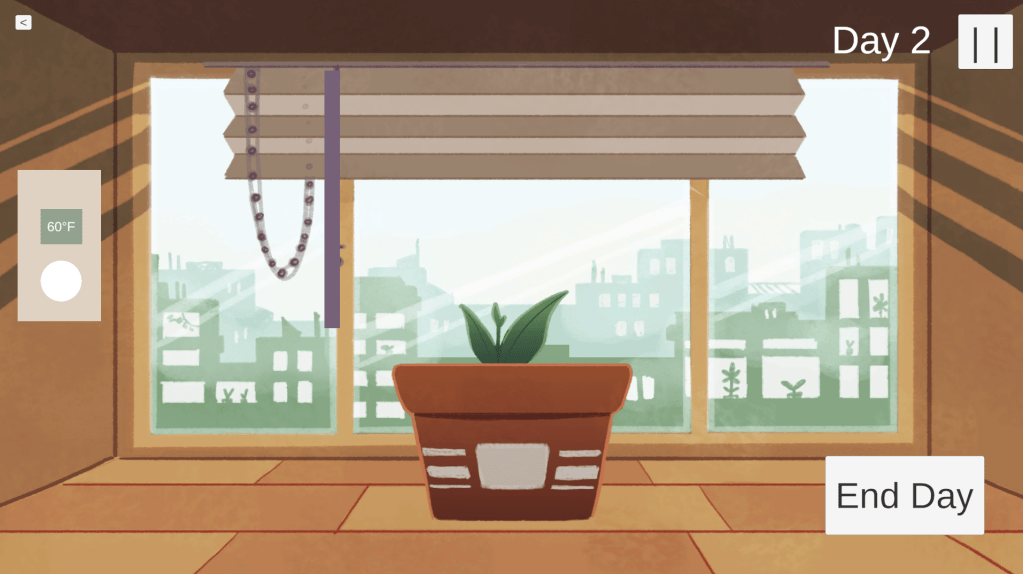
- Thermostat System – The player could adjust the temperature by turning a dial. The correct temperature for the plant is never revealed.
- Light/Blinds System – The player has indirect control over the amount of light given to the plant using a physics-like pull mechanic on the blinds, making getting the correct amount of light frustrating.
All of the interaction systems were built to be finicky and imprecise, contributing to the player’s overall feeling of frustration.
Early Development
Alongside design work, I contributed to early implementation and iteration:
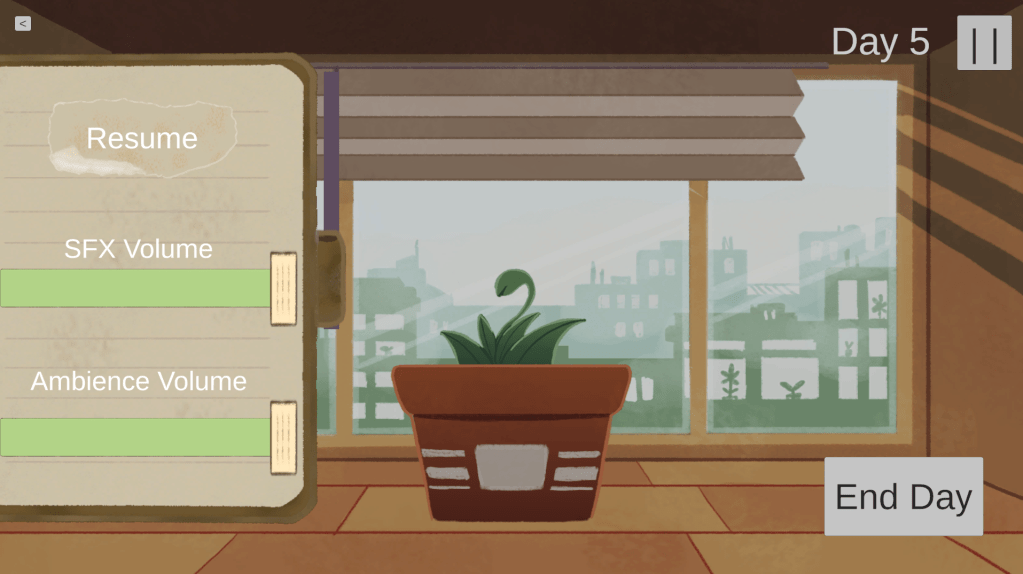
- Implemented UI systems, including the pause menu and interactive controls.
- Prototyped input interactions (Dial behavior, UI sliders, click-and-drag mechanics)
- Collaborated on integrating gameplay systems into a cohesive scene.
- Supported rapid iteration through paper playtesting, using player confusion and frustration as key metrics.
Mentorship
Alongside my development work, I also supported teammates by helping them work through technical implementation challenges in Unity and by offering feedback on how systems could be structured in a way that would allow future developers being onboarded onto the project to understand them more clearly. This was extra important for this project, as we knew many new people were going to be joining this project.