As an exercise for my game design muscles, I’ve taken a deep dive into Valorant’s character design, and created a new agent concept themed around my heritage.
Riding in from the plains of Uruguay, the wandering freedom-fighter Gaucho joins the fray!

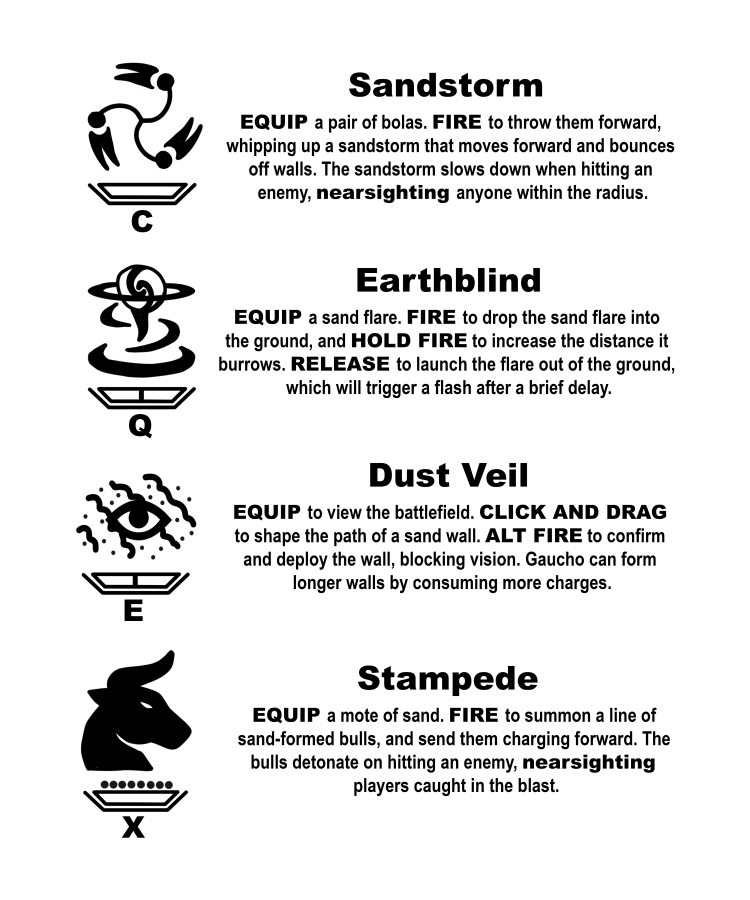
Click here to view Gaucho’s detailed ability kit.
To be clear – this character is NOT an official Valorant Agent! Its simply a character concept that I’ve created as part of my deep dive to understand Valorant’s agent design principles.
This journey all started when Valorant first released the new(ish) character Tejo, an intelligence consultant from Colombia. I was extremely excited to see more latino representation in the game, and I loved Tejo’s characterization and gameplay. It made me consider characters that I culturally relate to, and I started thinking about how in all of gaming, characters are never from my country – Uruguay.
Now, in some ways, this does make sense. Uruguay is a very small country with a population of about 3 million – which means that Uruguayan players would make up a very small percentage of any game’s playerbase. On top of that, we share a lot of our culture and traditions with the country of Argentina, what with the capital city of Buenos Aires being just across the river from Uruguay’s capital of Montevideo (Buenos Aires, by the way, has a population of about 3 million just by itself).
One purpose of creating a roster of characters from all around the world is to give players characters they can truly relate to, in terms of not just gameplay but also identity and culture. A diverse roster of characters of different nationalities and backgrounds goes a long way in ensuring all players feel included and connected to the game’s cast. However, creating well fleshed-out characters with interesting writing, gameplay, and art takes a lot of effort and resources, and there are nearly 200 different countries in the world. Creating a character for every country is impossible. So, a game studio may decide it’s better to create a character from a country that a greater percent of their playerbase can directly connect to – such as Argentina – than from one of the many small countries like Uruguay.
Still, I was determined to bring to fruition an idea for one of the first Uruguayan characters in mainstream gaming, somebody I could finally directly relate to. (As Valorant agent designer Ryan Cousart said when designing the Filipino agent Neon, “You want to find that agent, that’s yours. Or that you can say ‘I’m that.’”) I figured it would be a great exercise in terms of gameplay design for a tactical shooter like Valorant, and I wanted to create a character that reflected an aspect of Uruguay’s extensive culture and traditions. So I started developing an idea based on one of the most beloved cultural elements of the Río de la Plata region – the Gaucho.
Ability Rundown
This section gives a rapid rundown of Gaucho’s abilities, for those who want to see Gaucho’s abilities without hearing me talk about the process of creating Gaucho and his ability kit. If you’d like to learn about my process, I would recommend instead starting at part 1, Finding the Character’s Theme. A more detailed breakdown of each ability is available at the bottom of the page.
[C] – Sandstorm
Throw out a sandstorm that slows down and nearsights enemies caught within.
Type: Vision Denial / Area Control
Charges: 1
Cost: 250
Equip Time: 0.8 seconds
Unequip Time: 0.6 seconds
Weapon Reequip Speed: Fast
Simple Description:
- EQUIP a pair of bolas. FIRE to throw them forward, whipping up a sandstorm that moves forward and bounces off walls. The sandstorm slows down when hitting an enemy, nearsighting anyone within the radius.
Detailed Description:
- When C is pressed, Gaucho will equip a set of bolas. Gaucho can press fire to throw the bolas forward at leg-level.
- On firing, the bolas will move forward at 8 meters per second. After 0.75 seconds of releasing the bolas, a circle forms on the ground around the bolas, with a churning sandstorm visual that sticks low to the ground. The circle moves along with the bolas, with the bolas acting as the center of the sandstorm.
- The circle has a radius of 3 meters. When an enemy enters the radius, the bolas slow down to 2 meters per second. Any enemy within the radius becomes nearsighted, unable to see clearly beyond a short 7.5 meter radius. On exiting the radius, the enemy remains nearsighted for 0.1 seconds.
- When no enemies are inside of the circle, the bolas speed back up to its default speed.
- The bolas and its sandstorm expire after the bolas have traversed a total distance of 40 meters.
- Allies that are within the sandstorm also become nearsighted, but the bolas do not slow down if only allies are within the radius.

Gameplay Use:
- Flushing enemies out of cover
- The moving sandstorm forces enemies to reposition if it drifts near them, since being inside of its radius makes them vulnerable.
- Entry denial
- On defense, throwing Sandstorm into a choke or corridor can delay/disrupt attackers, as enemies who try to push risk being nearsighted.
Additional Notes:
- Note that the sand burst does not persist. It’s an instant effect.
- If we want to make the ability more powerful, it could also slow enemies caught within its radius.
[Q] – Earthblind
Burrow a blinding burst of sand underground that erupts upward when released.
Type: Flash / Blind
Charges: 2
Cost: 300
Equip Time: 0.8 seconds
Unequip Time: 0.6 seconds
Weapon Reequip Speed: Normal
Simple Description:
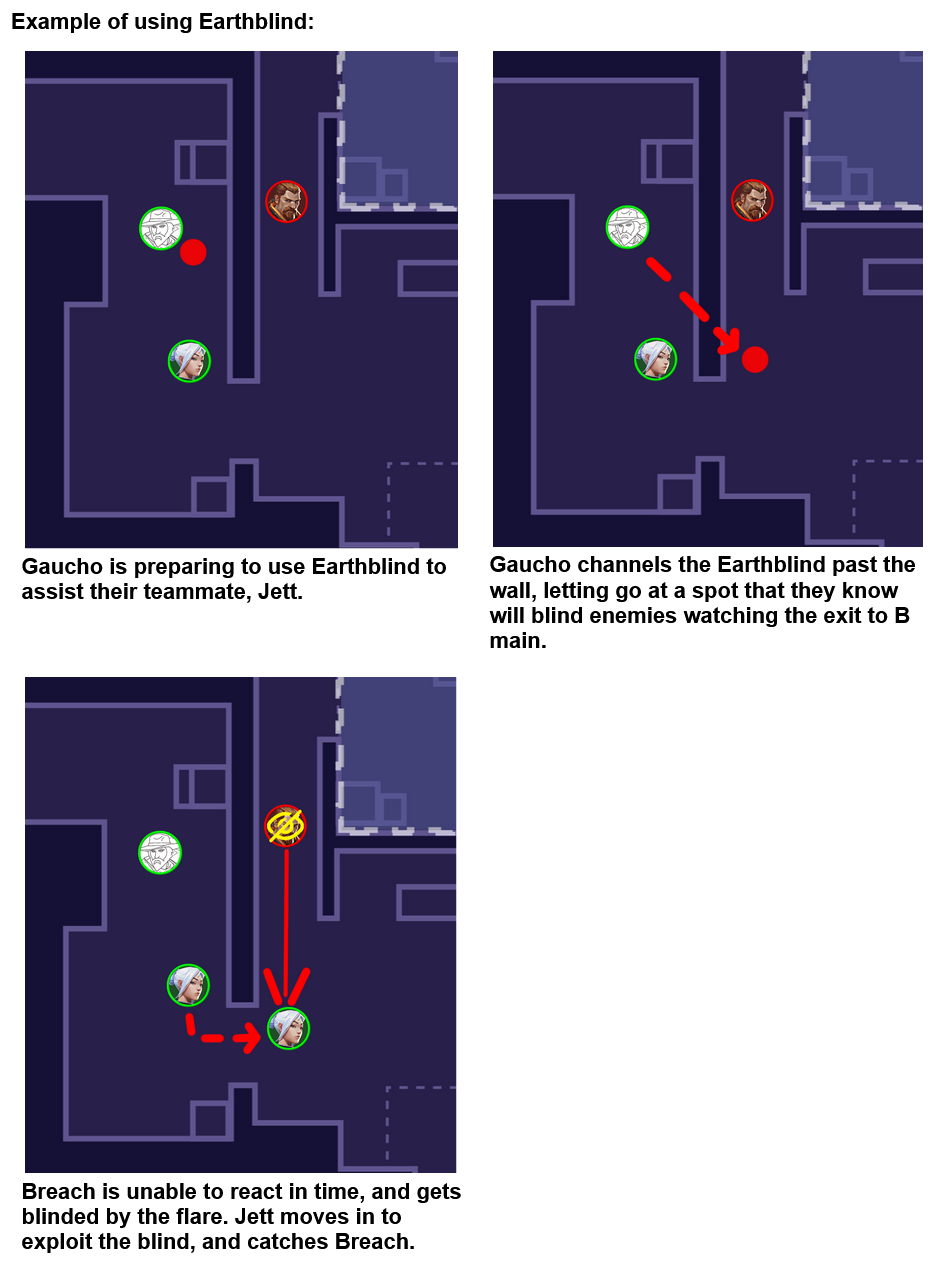
- EQUIP a sand flare. FIRE to drop the sand flare into the ground, and HOLD FIRE to increase the distance it burrows. RELEASE to launch the flare out of the ground, which will trigger a flash after a brief delay.
Detailed Description:
- Gaucho summons a handful of shimmering sand. When fire begins to be pressed, Gaucho will drop the shimmering sand on the ground, and a circular silhouette will appear on the ground in front of him. Gaucho will also begin channeling, able to move at 50% speed while channeling the ability. As long as fire is held down, the silhouette will slowly travel forward at a rate of 4 m/s, in the direction Gaucho was facing when they fired the ability. The longer the fire button is held, the farther the ability travels.
- When fire is let go, a flare of sand erupts from the ground at the location of the silhouette. The flare is an orb of sand that moves 1 meter into the air above the ground, before remaining stationary. After 0.75 seconds from exiting the ground, the orb bursts into a flash, blinding enemies facing the flash for 1.75 seconds.
- The maximum distance that the ability can travel out to is 20 meters. Once the ability reaches its maximum distance, the ability either activates if the silhouette is in a valid location, or is wasted if the silhouette is in an invalid location (such as within a wall or out of bounds of the map).
- This ability is able to be cast through walls and other obstacles, as the sand flare travels underground.
Gameplay Use:
- Pushing passageways / site entry
- Much like other flash abilities, this flash is effective for entering through watched passageways by blinding covering enemies.
- Combos well with Dust Veil, as you can use a sand wall to cover your vision while the flash is activating, and then push through the wall once it has activated.
- Rewards strong coordination with teammates
- Since the flash ability can be cast through walls and obstacles, it rewards careful coordination with teammates who can push Gaucho’s flashes even when Gaucho is not leading the charge.
- Gaucho is able to flash for teammates without actively participating in the firefight, as they could be behind a wall in another segment of the map.
Additional Notes:
- It’s worth noting that this ability has some unique strengths compared to other blind abilities, as it is able to go through walls and also does not reveal the location of the caster. These aspects may mean that the ability is too powerful, and could require some changes to improve counter-play. Potential changes would be to make the sand orb destructible in the period where it has exited the ground before flashing, allowing enemies to avoid the flash by quickly shooting the flare as it appears. A visual cue, such as a circle of broken terrain, could also be added to show the flare’s location while it is underground, giving enemies an extra opportunity to notice the flare and look away before it exits the ground.
[E] – Dust Veil (Signature Ability)
Deploy sand walls across the battlefield that block vision.
Type: Line Smoke
Charges: 2
- Gaucho gains one free charge each round.
Cost: 150
Equip Time: 0.8 seconds
Unequip Time: 0.7 seconds
Weapon Reequip Speed: Fast
Simple Description:
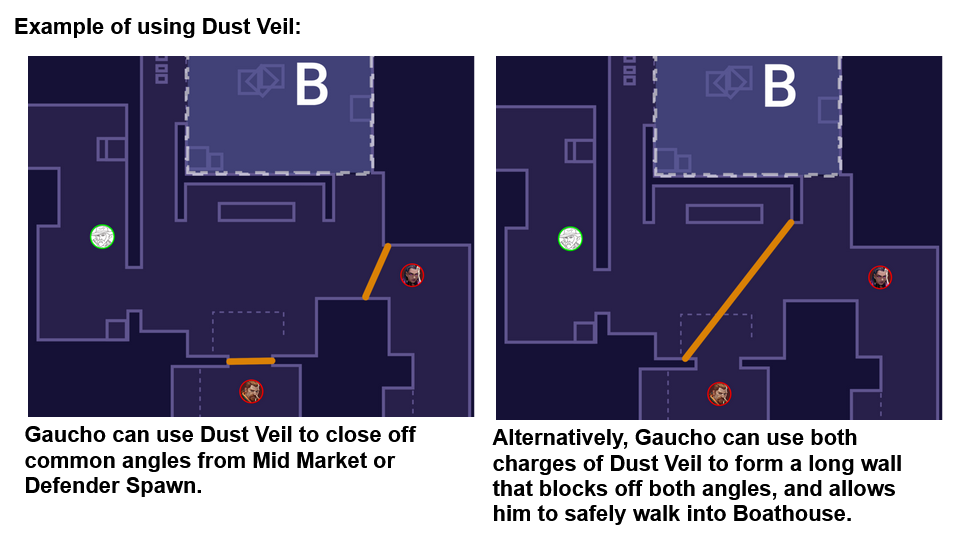
- EQUIP to view the battlefield. CLICK AND DRAG to shape the path of a sand wall. ALT FIRE to confirm and deploy the wall, blocking vision. Gaucho can form longer walls by consuming more charges.
Detailed Description:
- Press E to open a tactical map view (similar to Brimstone or Clove).
- Click and drag to set the path of a sand wall. When satisfied, press alt-fire to confirm placement. Confirmed sand walls deploy after 1 second.
- The sand walls are a form of smoke wall, similar to viper wall, phoenix wall, and harbor wall; the wall can be moved and shot through but not seen through.
- Each wall segment costs 1 charge. If a drawn wall exceeds the maximum length for 1 charge, additional charges are automatically consumed to extend it.
- This means that with two charges, you can create two walls of up to 9 meters each, or one wall of up to 18 meters.
- Max Length per Charge: 9 meters
- The sand walls remain deployed for 19.25 seconds, with an expiration warning at 17.75 seconds.
- Walls are tall and opaque, blocking vision.
Gameplay Use:
- Cut off multiple entry points or slice through a single long sightline with flexible walling.
Additional Notes:
- This is an ability that will require some amount of fine tuning on the max wall length and number of charges to balance properly. The current numbers were used based on a small tool I created to better measure the lengths of passageways and entrances in various maps in Valorant; But I’m sure that there are some inconsistencies in my tool compared to the actual distances in-game.
[X] – Stampede
Fashion five bulls from sand which charge forward to blind and slow enemies.
Type: Vision Denial / Area Control
Point Cost: 8
Equip Time: 1.1 seconds
Unequip Time: 0.7 seconds
Weapon Reequip Speed: Normal
Simple Description:
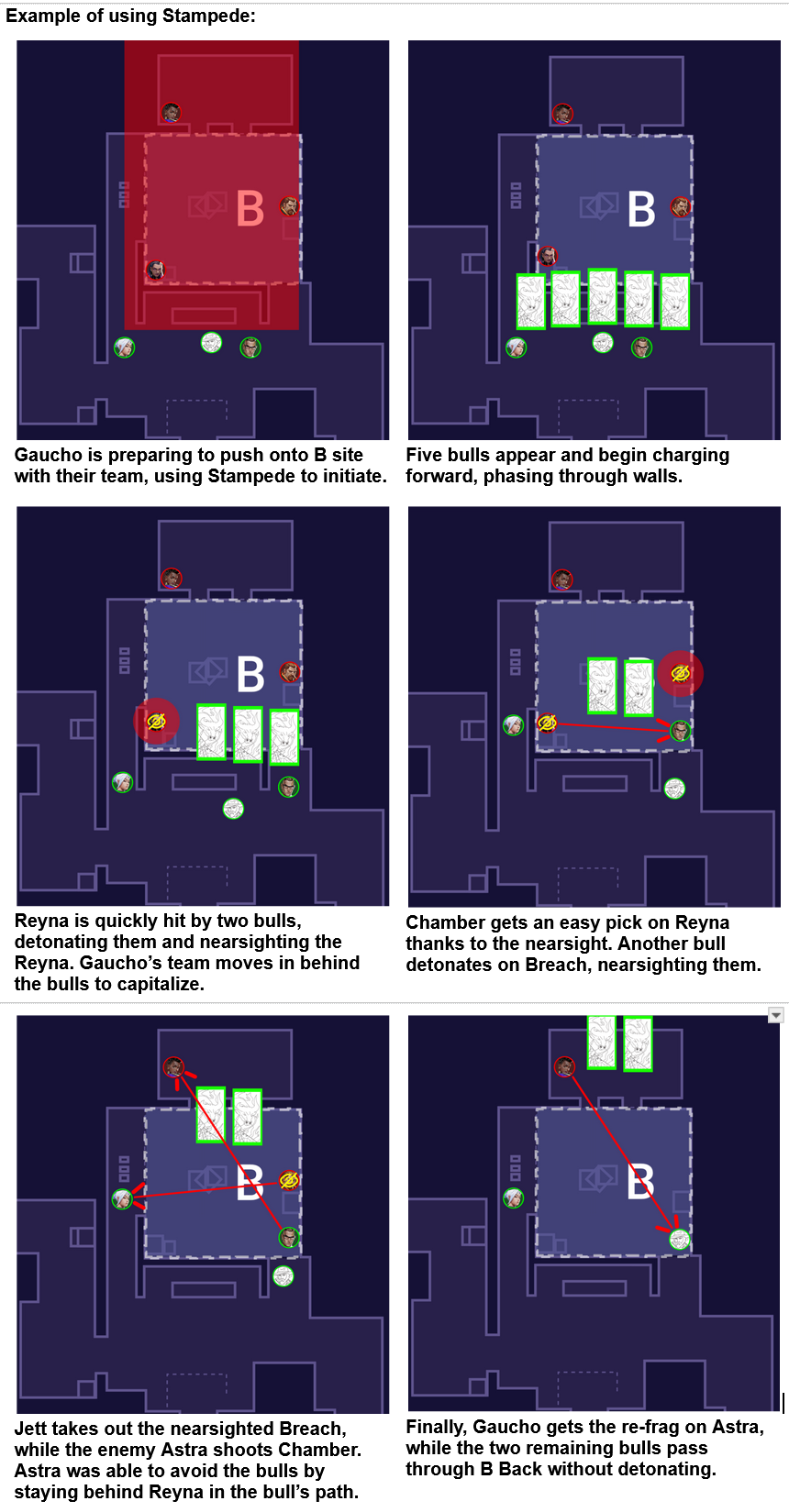
- EQUIP a mote of sand. FIRE to summon a line of sand-formed bulls, and send them charging forward. The bulls detonate on hitting an enemy, nearsighting players caught in the blast.
Detailed Description:
- Gaucho takes 0.6 seconds to summon five bulls made of sand in a line in front of him. Each bull is 4 meters wide by 6 meters long, standing side-by-side. All together, the line of bulls is 20 meters wide.
- All bulls begin charging forward, traveling at a speed of 4 meters / second. The bulls accelerate at a rate of 4 meters / second squared, until they reach a maximum velocity of 16 meters / second.
- Any bulls that travel 40 meters simply dissipate.
- When a bull comes into contact with an enemy, the bull detonates in a burst of sand, becoming destroyed. This nearsights all players within a radius of 3 meters from the point of contact, and destroys the bull. The nearsight effect lasts for 2 seconds, and limits the target’s sight to 3 meters.
- When the bull comes into contact with an ally, the bull does not detonate and simply passes through them. However, the ally is still nearsighted for 2 seconds, limiting the target’s sight to 3 meters.
- The bulls phase through walls and obstacles, and always travel along the ground.
Gameplay Use:
- Site/Area Entry
- Similar to Breach’s ultimate, Stampede can be used to clear out defenders holding common angles.
- The bulls will force enemies to either reposition or risk getting nearsighted, making them easy targets for attackers that advance with the stampede.
- Counter-push
- Stampede can be used to counter a squad of attackers that are using heavy utility to enter a site, with the nearsight effect forcing them to retreat back into cover.
Additional Notes:
- Depending on what we want from Gaucho’s visual theme, this ability could easily be a stampede of horses with the same effect.
- If we want the ability to be more powerful, the bulls could also create a lingering zone of sand when they detonate, which slows players walking over the sand.
- Players can attempt to avoid triggering multiple detonations by stacking up behind one player, allowing the player in front to detonate the bull and tank the nearsight effect, forming a hole in the line of charging bulls.
1. Finding the Character’s Theme
First off, what is a “Gaucho”?
The Gaucho is a folk symbol of the Pampas region of South America, a fertile plain that occupies much of eastern Argentina, Brazil’s southernmost state, and all of Uruguay. Appearing in the 18th and 19th centuries, they bear a lot of similarities to the U.S. concept of a “cowboy,” as they were skilled migratory horsemen who made a living off of cattle farming. In the mid-18th century, a profitable opportunity in supplying European traders with hides and tallow gave rise to a large number of gauchos taking up the hunt of large herds of escaped horses and cattle roaming the Pampas. Their tools of choice were the lasso, a large knife called a facón, and a set of bolas used for immobilizing animals.
One aspect that makes the Gaucho such a renowned symbol for Uruguay is that they are celebrated as heroic folk of combined European and Native American ancestry. They carried on the practice of many indigenous traditions while combining them with religion and culture inherited from Europeans, and they were known to often sing and tell stories of their history around the campfire while roaming the Pampas plain. During Uruguay’s war for independence in the early 19th century, many Gauchos joined the independence movement and became a mainstay of the revolutionary army, where they fought from horseback using wooden lances. Their knowledge of the land proved invaluable and their bravery and prowess gave rise to numerous ballads and legends that immortalize them to this day.

2. Analyzing Valorant’s Design
Valorant is an objective-based tactical first-person shooter that borrows elements of the hero-shooter genre. This means that precise gunplay is blended with unique character abilities.
Matches are played in a 5v5 format, where one team attacks by planting a “spike” (bomb) on one of 2-3 sites on a map while the other defends these objective sites, with roles swapping halfway through. The gameplay emphasizes tight shooting mechanics but layers on strategic depth through a diverse roster of “Agents,” each with their own abilities that can control space, gather information, or create tactical advantages.
What sets Valorant apart from other shooters is its fusion of high-precision gunplay and hero-based abilities. Unlike purely aim-focused shooters, success in Valorant relies equally on mechanical skill, smart ability usage, team composition, and coordination. Its maps are designed with tactical choke points, verticality, and unique interactive elements that reward strategic planning. The result is a game that feels as much about mind games, smart positioning, and rapid adaptability as it does about landing the perfect headshot.
What I want to do now is analyze some of the elements of Valorant’s design, and how they shape the game into this tight tactical shooter. I also want to find out what kind of effect the gameplay has on the design of agents – and also what kind of effects agents have on the gameplay.
So, what differentiates Valorant from other shooter games? What puts the “Tactical” into Tactical Shooter? To find out, I divided my research into three distinct categories, and wrote extensive notes on each.
- Movement & Shooting: Valorant’s shooting and movement mechanics are unique compared to other shooters; As a whole, Valorant’s mechanics enforce a slow and steady playstyle over its higher-octane competitors.
- Slow Movement compared to other shooters (Like Call of Duty or Titanfall)
- Even Rainbow Six Siege, another shooter game with a heavy emphasis on tactics, gives the player the ability to sprint. In Valorant, your sprinting and walking verbs are switched – you “run” by default, and holding shift allows you to walk which makes you much more accurate in shooting and silences your footsteps.
- Can’t Lean
- Requires the player to expose a large portion of their body to fire at an enemy from behind cover. This ensures that participating in a firefight is never safe or one-sided.
- Players are slowed when shot at
- This highlights an emphasis on good positioning. Being caught out in the open means a swift death, as you have no hope of making it behind cover when you’re being fired at; Instead, players need to make sure they stick to cover closely at all times and never expose too much of themselves to a sightline.
- This factor also puts a greater emphasis on approaching a firefight with a numbers advantage; Since you can’t reposition quickly after dueling with an enemy, it’s easy for an opponent’s back-up to take you out after you score a kill (often called a “re-frag”), resulting in an even reduction in the balance of power in a match.
- Players are inaccurate when shooting while moving
- This means that defenders holding a position get an inherent advantage over attackers swinging out of cover, as the attacker will be unable to shoot properly for a short duration. This serves not only to reduce “peeker’s advantage” in play, but also makes holding angles a critical part of the game.
- Unique recoil & emphasis on “Calm Aim”
- Valorant’s guns each have distinct recoil patterns that are difficult to account for when firing. Spraying wildly is heavily punished, and success instead often relies on “calm aim”: controlled bursts and patiently lining up a headshot in firefights. This design slows down engagements and rewards careful aiming over chaotic spraying.
- Wall Penetration
- Many surfaces in Valorant can be shot through, with different materials offering varying levels of bullet penetration. This prevents players from being completely safe behind thin cover and adds another layer of tactical decision-making where positioning, sound cues, and pre-firing become critical skills for both attackers and defenders.
- Slow Movement compared to other shooters (Like Call of Duty or Titanfall)
- Economy & Utility: A unique aspect of Valorant is that all weapons and utility (character abilities) need to be purchased every round within a game, rather than having your character start with a pre-set loadout. Valorant’s economy system plays a critical role in shaping the pacing and tactical decisions of each match. It forces teams to think beyond the current round and weigh the long-term impact of their spending.
- Players earn money each round based on performance
- Each round awards credits for kills, planting/defusing spikes, and round outcomes. The losing team each round also gets a smaller payout, ensuring they can eventually recover with smart economy management. This system means players must constantly consider whether to invest heavily in the present round or save for a stronger buy later.
- Guns have different costs & uses
- Weapons vary in price, recoil, accuracy, shooting modes, and damage output. Certain weapons are considered generally better than others – rifles, for example, are generally considered the best all-around option if you can afford them, though certain situations may also call for using shotguns or snipers. Pistols and submachine guns, meanwhile, are generally cheaper weapon options, but require you to take fights at close-range in order to best utilize them. This allows for “full buy rounds,” “half buys,” and “eco rounds,” each prioritizing a distinct balance between cost vs. power.
- Your choice of weapon also alters your strategy. A team on pistols may play close quarters to maximize their low-cost weapons, while a fully equipped team can take longer-range fights with rifles.
- Utility (character abilities) are purchased
- Unlike many hero shooters where abilities recharge automatically, Valorant requires players to purchase most abilities at the start of a round. This adds another resource management layer, since you may skip buying an agent’s incendiary grenade or owl drone ability to afford a better weapon, or vice versa.
- This mechanic also gives us another lever to tinker with in balancing character abilities – cost! Lowering an ability’s cost will increase its power, as it can be afforded more easily, and vice versa if the cost is increased.
- Weapon scavenging & saving
- Weapons that a player is holding are dropped on the ground when they are killed, and another player can pick it up. This means that enemies with a cheaper/weaker gun are rewarded when they kill an enemy with a more expensive gun, as they can pick up the opponent’s weapon and use it without spending the money on purchasing it.
- Surviving to the end of the round with a weapon means that you retain it at the start of the next round, which preserves your investment and can even swing momentum to your favor if it’s a powerful/expensive weapon. This creates tense end-of-round situations where retreating and living to fight another day while retaining your weapon (called “saving” the weapon) is the smart play over going for a risky clutch.
- Ultimate abilities are charged with kills
- Ultimates are powerful game-changing abilities earned through kills, spike plants/defusals, or collecting orbs placed in certain midpoints of each map. This adds a secondary economy of “ultimate points,” making some rounds worth playing differently just to secure an orb for a powerful play in the current round or the next.
- This system also rewards players who are getting a lot of kills on enemies with quicker access to their ultimate abilities.
- This system gives us another lever with which to tune our agents. We can lower the power of an ultimate ability by increasing the number of points it costs, ensuring it is used less frequently throughout a game.
- Good economy and utility allows you to tip the balance in your favor
- A team with superior gear and well-timed abilities can dominate choke points, clear sites, and survive retakes more effectively. Poor economy often forces riskier plays and creative tactics to offset the disadvantage.
- Players earn money each round based on performance
- Map Layout & Round Phases: Valorant’s round structure contributes to its tactical depth by creating predictable phases of engagement, and the map design allows for smart positioning, deception and misdirection to form a core part of the gameplay loop.
- Objective Sites
- Each map contains two or three bomb sites, each with distinct entry points, sightlines, and potential defensive setups. Their layouts encourage different attack and defense strategies, making site selection a round-by-round mind game.
- Pre-Plant
- The round begins with attackers attempting to approach a chosen site without being picked off, while defenders aim to gather early information on where enemies are located and stall pushes so that allies that are holding on another site can reinforce the site that is being attacked.
- Post-Plant
- Once the spike is planted, the dynamic shifts entirely. Attackers now play defensively, holding angles and using abilities to delay defusal, while defenders coordinate a retake. Abilities that deny area and delay time (like smokes, walls, or incendiaries) become critical here.
- Maps Tightly Restrict Vision
- Valorant’s maps use narrow choke points, sharp corners, and elevation changes to limit long lines of sight. This design choice magnifies the importance of using utility to gain or deny information and vision. Smokes, flashes, and recon tools are often the difference between a clean push onto a site and a failed entry.
- Clear artstyle and visuals
- Valorant’s maps are designed not just with tactical function in mind but also with visual clarity. Each bomb site, lane, and choke point uses strong color palettes, environmental themes, and distinctive landmarks, ensuring players can instantly orient themselves and communicate callouts effectively. This clarity reduces confusion in fast-paced situations and supports the game’s tactical depth by making information sharing clean and reliable.
- Objective Sites
3. Agent Design Pillars
Section 2 (above) makes for a good analysis of some key parts of the game, but how does my analysis apply to the creation of agents? How can it inform what I focus on when creating a character’s ability kit? Well, using the analysis I conducted, I’ve distilled some of the game’s key aspects into the following four crucial agent design pillars.
- Gunplay First
- Agent’s powers should never replace core FPS skills; they should complement them.
- Abilities are designed to create opportunities in gunfights, or an unfair advantage, not win fights outright.
- When designing an Agent consider:
- Your abilities shouldn’t be free kills or hard auto-win buttons. Instead they should change the conditions of a fight.
- Flashes, for instance, create an opening for attackers pushing an enemy position, but require follow-up with gunplay.
- Every Ability Has Counterplay
- Abilities always have clear telegraphs (sounds or visuals) and some form of avoidance or response. A player can glance away from flashes, or run out of the damage zone for Breach’s Aftershock ability.
- There should be multiple solutions for countering or mitigating an ability. This could include timing, position, another ability, or overcoming the ability with raw aim.
- When designing an Agent, consider:
- “If this hits me, do I have a chance to react?”
- “Can the enemy do something about this ability if they predict it?”
- For example, while Breach’s Fault Line is powerful, it has an obvious windup sound and visual cue while also leaving Breach open to attack while charging – players can dodge the ability or push onto Breach directly.
- Information and Space Control are Currency
- Valorant is as much about where and when fights happen as about winning them.
- Vision control, chokepoint denial, and area control are vital strategic layers.
- This is why many abilities focus on smoke, walls, recon, and area denial.
- When designing an Agent, consider:
- “How does this Agent influence where the fight happens?”
- “Does their kit let them take or deny control of key map chokepoints and zones?”
- Controllers like Viper and Brimstone excel at shaping sightlines to their advantage; Initiators like Sova reveal enemy positions; Sentinels like Killjoy lock down flanks and entrances.
- Clarity and Readability
- Abilities must be instantly recognizable in the chaos of battle.
- Players should be able to identify who cast it, what it does, and how dangerous it is at a glance.
- When designing an Agent, consider:
- Keep thematic cohesion – all abilities should visually and audibly fit the Agent’s identity.
- Use consistent VFX colors, shapes, and sounds that are readable without being confused for other Agents.
- Avoid overly noisy or flashy effects that reduce a player’s ability to tell what is happening on-screen.
Furthermore, based on information that I’ve been able to gather online, it seems that Riot typically defines an agent’s role (Controller, Duelist, Sentinel, Initiator) early, then ensures their abilities:
- Serve their role’s primary team function.
- Offer multiple playstyles and creative uses.
- Have both strengths and exploitable weaknesses.
- Fit the lore and thematic tone of Valorant.
They also ensure that the new agent:
- Brings something new that no exiting Agent does,
- But doesn’t replace or make obsolete a current Agent.
Now, I’m actually approaching this a little differently to how Riot would begin designing a character. As stated above, they typically start by defining a role that needs to be added to the game – Controller, Duelist, Sentinel, or Initiator – and then they start on the ability and thematic design from there. Since the thought that prompted me to go on this design journey was that I wanted to create one of the first Uruguayan characters, I am starting this design process a little differently, since I already have a good idea of some of the thematic elements I want to see in this character before I’ve even started thinking about what role the character would embody. However, with all of this information in mind, I went to the drawing board, and began designing the character Gaucho.
4. Creating the Character
First, I had to decide on the character’s role. Originally, I was between two options – either a Sentinel or a Controller. At the beginning I was leaning towards creating a Sentinel, since I always enjoyed the Sentinel’s gameplay of tactically placing down traps and info tools. I instantly started thinking about a character that could create sandy “mirage” copies of themselves that are placed and activated around a site, allowing the player to teleport between those copies and having the copies blind enemies when shot at. However, I realized that this ability set was not only becoming too complicated, but also had a lot of abilities that relied too heavily on other pieces of the kit – for example, the ability to teleport to a sand clone would require the player to use a charge of their clone placement ability, and then a charge of their separate teleportation ability.
This meant that the kit was not very versatile, as any one ability couldn’t be fully used on its own (and may as well not be purchased without the other pieces of the kit), and it also meant that one simple movement action required the expenditure of two different valuable abilities in a round (This is actually a current issue with the balance of Valorant’s agent Waylay – her primary method of entry requires her to fully expend two abilities, leaving her without many options once she has dashed into an area). There is also already an ability that bears a lot of similarities to this concept in the game – Yoru’s clone.
I then pivoted to thinking of Gaucho as a Controller character. I kept the sand theme in this switch – I thought it was actually perfect for a controller role, as I envisioned the character creating sandstorms that would control an enemy’s vision. I also thought about what kind of niche Gaucho would occupy in the game. I found that there was a perfect opportunity to introduce a Controller character with an initiator lean to them – especially since there wasn’t yet a Controller character with a flash ability.
In the end, I decided that I would design a Controller agent with a heavy emphasis on vision control, not only by blocking angles with smokes but also by flashing and nearsighting enemies to allow their team to enter a site or area. I also want this agent to require a large amount of coordination with their team, ensuring that their flash and nearsight abilities are well timed and do not backfire.
So without further ado, here is the document that I have been working on for the past several months – the fan-made design of a new Uruguayan agent, Gaucho!
My full design document for Gaucho can be found on this google doc, and this is the document that I will keep updated as I continue working on Gaucho and making small changes. The abilities in their present state can also be seen below:
 Sebastian Bolatto's Portfolio