
At Consolidated Nuclear Security, I worked with the Oak Ridge Enhanced Technology and Training Center (ORETTC) to create two different experiential learning tools.
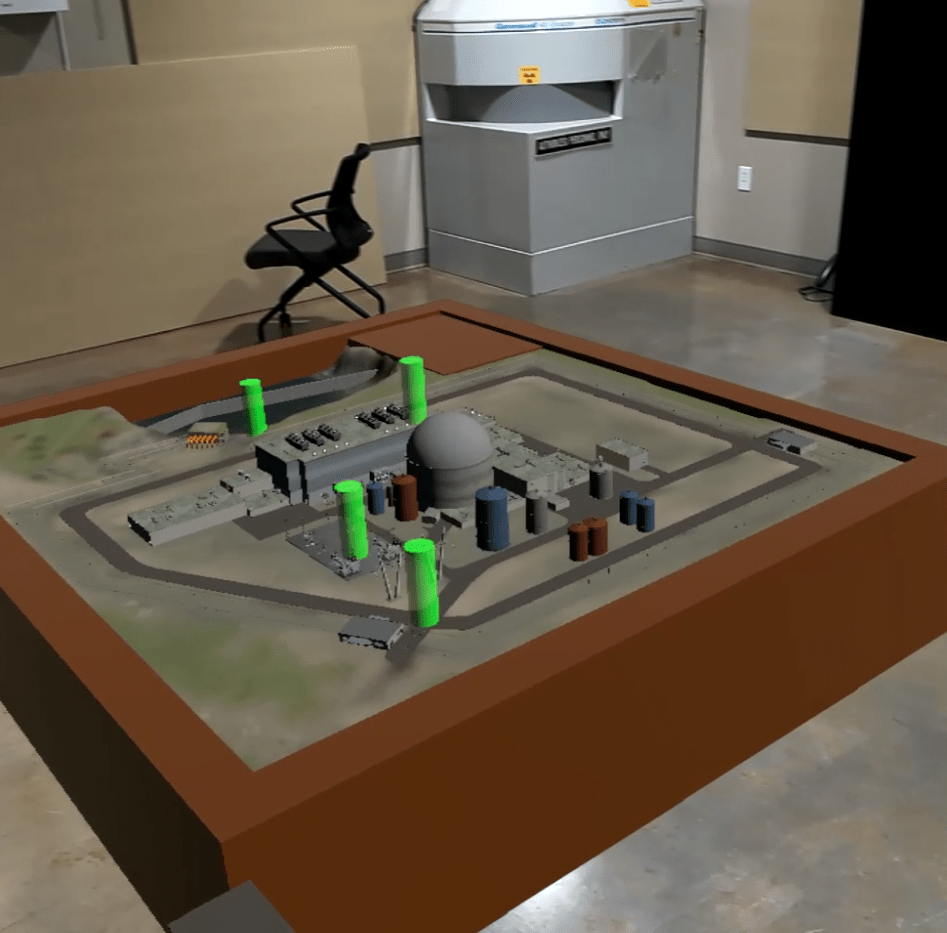
One of my projects was the Lone Pine Nuclear Power Plant facility tour, which was an interactive virtual tour of a fictional but realistic nuclear facility. In this project, I used a detailed 3D model within an interactive virtual environment to grant users a familiarization of the inner workings of a nuclear facility in a safe and informative manner. The goal was to provide educational content that explains the purpose and function of rooms, systems, and processes within the facility. This simulation also laid the groundwork for future interactive training scenarios within the fictional facility, such as emergency response drills or operational simulations.
Features of the Lone Pine Nuclear Power Plant facility tour include:
- Users can observe the facility from an AR tabletop view that has been imposed onto the real world, allowing uses to view the full facility exterior and interior by separating it into distinct layers.
- Users can touch points on the table to enter an immersive VR view of the selected location with detailed information about the room.
- All interactions with the simulation are done via hand tracking, ensuring ease of use for those unfamiliar with XR.
Another project was named Giants of Oak Ridge, where I built a companion app for a statue installation of notable figures important to U.S. nuclear history in Oak Ridge’s A.K. Bissell Park. The statues are given pictures that when viewed through the app, cause a detailed model of the figure to appear and move. The figure is able to interact with the user and answer the user’s questions direction through speech. An LLM is used to detect the intentions behind a user’s question, and assign a corresponding pre-set answer to the question. It also uses an AI-generated voice trained on writings and recordings of the figure, with consent from the figure’s family.
Features of the Giants of Oak Ridge project include:
- User is able to place their phone camera over a specific image to have a figure appear and move around within their camera view.
- User can communicate with the figure using their own voice. An LLM is used to select a pre-set answer to respond with.
- Application is hosted on the web using a general browser library to ensure the application can be easily accessed and used on any device.
Both projects demonstrate the potential of XR to make technical and historical content more engaging, accessible, and educational.
For another project, I utilized Unreal Engine to develop a VR training simulation featuring a thermal haptic glove. In this project, I used thermal feedback to train uranium workers in nuclear safety and detecting the signs of nuclear criticality. The simulation placed users within a realistic uranium facility and ran users through a step-by-step uranium processing process to get uranium workers accustomed to the process in a safe environment. It utilized VR goggles and haptic gloves to give users as life-like of a simulation environment as possible, ensuring that the skills learned in the simulation would transfer to their work in the processing facility in real life.
I am not yet able to show in-engine footage of the project, but below are some pictures of me messing around with the haptic technology!


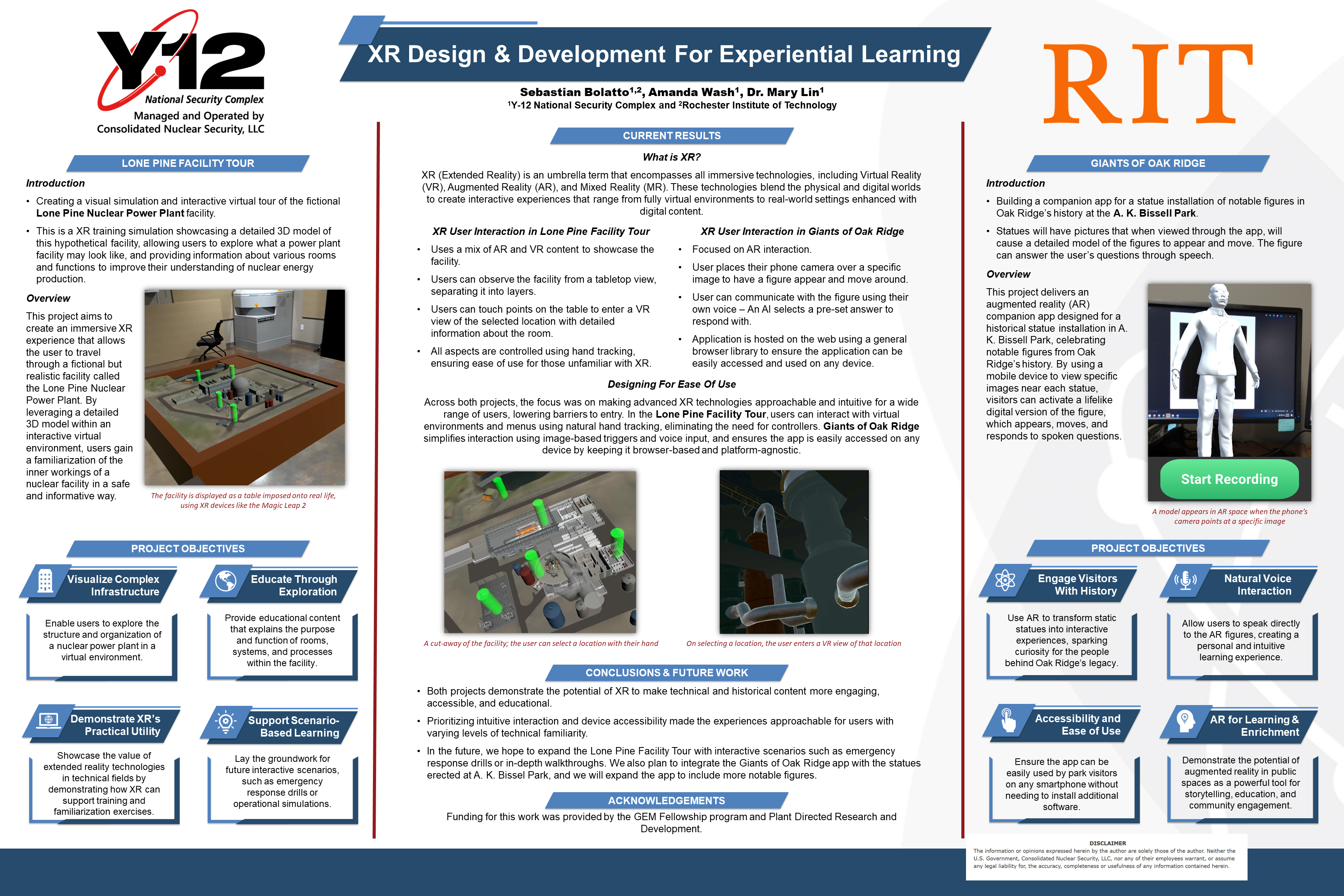
Below is an unclassified poster presentation I created, describing the challenges and processes of many of my projects:
 Sebastian Bolatto's Portfolio